You interact with erc20 tokens every time you use popular cryptocurrencies built on ethereum. These digital tokens follow the erc-20 standard, which sets clear rules for how tokens behave and move within the network. You can find over 1.4 million erc-20 tokens on ethereum, showing their widespread use. This standard lets you trade, store, and use tokens easily across many platforms.
Over 1.4 million erc-20 token contracts exist on ethereum.
Key Takeaways
ERC-20 tokens are digital assets that follow a standard set of rules on the Ethereum blockchain, making them easy to use across various platforms.
Over 1.4 million ERC-20 tokens exist, showing their popularity and widespread use in the crypto world.
ERC-20 tokens are fungible, meaning each token is identical and can be exchanged for another without any difference.
You can create your own ERC-20 token by following a simple process that includes writing a smart contract and testing it before deployment.
ERC-20 tokens allow for seamless transactions between wallets, exchanges, and decentralized apps, enhancing user experience.
Security is important; always use trusted platforms and double-check addresses to avoid losing your tokens.
The ERC-20 standard supports various applications, including decentralized finance (DeFi) and gaming, making it versatile and valuable.
Future developments in token standards may improve efficiency and security, but ERC-20 tokens will remain a key part of the Ethereum ecosystem.
ERC-20 Tokens Explained
What Is ERC-20
You may hear the term erc-20 often when you explore the world of crypto. The erc-20 standard is a set of rules that developers use to create fungible tokens on the ethereum blockchain. These tokens all follow the same technical standard, which means you can use them in many wallets, exchanges, and apps without any trouble. When you hold erc20 tokens, you know each one is identical and interchangeable with another. This makes erc-20 tokens perfect for uses like digital currencies, rewards, or voting rights in decentralized projects.
The erc-20 token standard helps you and other users interact with tokens in a predictable way. You can send, receive, and check your balance with simple actions. Because of this, erc-20 tokens have become the most common type of fungible tokens in the ethereum ecosystem.
ERC-20 Standard Overview
The erc-20 standard defines the technical requirements that every erc-20 token must follow. These requirements make sure that all erc20 tokens work smoothly across the ethereum network. You can see the main requirements in the table below:
Requirement | Description |
|---|---|
Token Balance | Tracks the balance of each token holder’s address. |
Token Transfer | Specifies methods for transferring tokens between addresses (transfer() and transferFrom()). |
Token Approval | Introduces the approve() method for authorizing another address to spend tokens on behalf. |
Total Supply | Maintains a record of the total supply of tokens with the totalSupply() method. |
Token Name and Symbol | Methods to retrieve the name and symbol of the token (name() and symbol()). |
Token Decimals | Allows specification of the token’s decimal places with the decimals() method. |
Events | Defines events like Transfer and Approval for tracking token movements. |
You benefit from these rules because they allow erc-20 tokens to work with many different platforms. The erc-20 standard gives you a universal set of rules for token interactions. This means you can use your tokens in wallets, exchanges, and decentralized apps without worrying about compatibility. Developers also find it easier to build new products that use erc-20 tokens, since the standard simplifies the process.
Key Features of ERC-20 Tokens
When you use erc-20 tokens, you get several important features that make them useful and reliable. The most common features include:
Feature | Description |
|---|---|
Fungible | All tokens created for use in a Dapp are identical and interchangeable. |
Transferable | Tokens can be transferred between wallets on the Ethereum blockchain. |
Constant Supply | New tokens must have a fixed amount from the start to prevent inflation. |
You can also interact with erc-20 tokens using several built-in functions:
TotalSupply: Lets you see the total number of tokens ever issued.
BalanceOf: Allows you to check the balance of a specific token owner's account.
Transfer: Lets you send a set number of tokens to another address.
TransferFrom: Lets you move tokens from one address to another automatically.
Approve: Lets you give permission to another address to spend a certain number of your tokens.
Allowance: Shows you how many tokens a spender can withdraw from your account.
The erc-20 token standard stands out because it supports divisibility, interoperability, and third-party spending. You can use erc-20 tokens for stablecoins, governance, DeFi, and in-game currencies. The uses of erc-20 tokens keep growing as more developers and users join the ethereum ecosystem. When you look at the erc-20 standards, you see how they help create a strong and flexible foundation for the entire ethereum network.
Tip: The erc-20 standard makes it easy for you to move your tokens between different apps and wallets. This flexibility is one of the main reasons why erc-20 tokens are so popular in the crypto world.
How ERC-20 Works on Ethereum
Smart Contracts and ERC-20
You interact with erc20 tokens through smart contracts on the ethereum blockchain. These smart contracts act as the backbone for every erc-20 token. When you use an erc-20 token, you rely on a set of rules coded into the smart contract. This code controls how you send, receive, and manage your tokens. The smart contract makes sure that every transaction follows the same rules, so you do not have to trust a third party.
Here is a table that shows the main functions you find in an erc-20 smart contract:
Function Name | Description |
|---|---|
totalSupply | Defines the total supply of tokens; no new tokens can be created once this limit is reached. |
balanceOf | Returns the number of tokens held by a specific wallet address. |
transfer | Transfers a specified amount of tokens from the total supply to a user. |
transferFrom | Transfers tokens between users, allowing for delegated transfers. |
approve | Verifies if a smart contract can allocate a certain amount of tokens to a user. |
allowance | Checks if a user has enough balance to send a specified amount of tokens to another user. |
You benefit from this structure because it keeps your erc-20 tokens safe and predictable. The ethereum ecosystem depends on these smart contracts to make sure every erc-20 token works the same way.
ERC-20 Functions and Rules
You use erc-20 tokens every time you send or receive digital assets on ethereum. The erc-20 standard gives you a clear set of functions and rules. These rules make sure that all erc20 tokens behave in a way you can trust. When you use an erc-20 token, you interact with functions that control how you move and manage your tokens.
Here is a table that lists the most widely used erc-20 functions:
Function Name | Description |
|---|---|
totalSupply | Returns the total supply of tokens in circulation. |
balanceOf | Returns the number of tokens held by a specific address. |
transfer | Transfers tokens from the sender's address to a recipient's address. |
approve | Allows a spender to withdraw tokens from the owner's account. |
transferFrom | Transfers tokens from one address to another on behalf of the owner, after approval. |
allowance | Returns the amount of tokens that a spender is allowed to withdraw from the owner's account. |
You use these functions to check your balance, send tokens, and let others spend your tokens if you want. The erc-20 standard also sets rules for how tokens move between addresses. This makes it easy for you to use your erc-20 tokens in wallets, exchanges, and apps across the ethereum ecosystem.
Note: The erc-20 standard does not allow you to create new tokens after the total supply is set. This rule helps prevent inflation and keeps the value of your tokens stable.
Token Creation Process
You can create your own erc-20 token on ethereum by following a few clear steps. The process uses tools and code to make sure your token follows the erc-20 standard. Here is a simple outline of how you create and deploy an erc-20 token:
Set up your development environment. You install tools like Truffle and OpenZeppelin.
Write your token contract in Solidity. You make sure your code includes all the required erc-20 functions.
Test your contract. You check that every function works as expected.
Deploy your contract to a test network like Sepolia. You make sure everything works before going live.
Add your token to a wallet like MetaMask. You test your token by sending and receiving it.
You do not need to be an expert to create an erc-20 token. Many developers use templates and guides to help them. When you follow these steps, you make sure your token works with the rest of the ethereum blockchain. This process helps you join the growing world of erc-20 tokens and take part in the ethereum ecosystem.
Tip: Always test your erc-20 token on a test network before you deploy it on the main ethereum blockchain. This helps you avoid mistakes and keeps your tokens safe.
Transactions and Interoperability
When you send or receive erc20 tokens, you rely on the rules set by the erc-20 standard. These rules make every transaction predictable and secure. You can move erc-20 tokens between wallets, exchanges, and decentralized apps without worrying about compatibility. The erc-20 standard gives you a common language for transactions on the ethereum blockchain.
You use functions like transfer() and balanceOf() to manage your erc20 tokens. These functions help you check your balance and send tokens to other users. Wallets such as MetaMask and Trust Wallet support these functions, so you can use your erc-20 tokens across many platforms. This compatibility makes it easy for you to interact with the ethereum ecosystem.
Here is a table that shows how erc-20 tokens ensure interoperability between wallets and exchanges:
Functionality | Description |
|---|---|
Compatibility | erc-20 tokens are designed to work with ethereum wallets. |
Balance Check | You can check your balance using the |
Token Transfer | You can transfer tokens using the |
Wallet Support | Wallets like MetaMask and Trust Wallet support these functions. |
You benefit from seamless communication between erc20 tokens, decentralized apps, and wallets. The erc-20 standard allows you to move assets easily and interact with different platforms. You do not need to worry about technical barriers when you use erc-20 tokens.
The erc-20 token standard lets you communicate and exchange assets with other users and platforms.
You can use your erc20 tokens in many wallets and exchanges because of standardization.
The interoperability of erc-20 tokens helps you participate in the growing ethereum ecosystem.
You see the impact of interoperability every time you trade erc20 tokens or use them in a decentralized app. The erc-20 standard makes sure your tokens work everywhere on ethereum. You can trust that your transactions will go through smoothly, no matter which wallet or exchange you use.
Tip: Always check if your wallet or exchange supports erc-20 tokens before you make a transaction. Most popular platforms in the ethereum ecosystem support these tokens, so you can move your assets with confidence.
Benefits of ERC-20 Tokens
Interoperability Across Platforms
You experience true flexibility when you use erc20 tokens. The erc-20 standard lets you move your tokens between wallets, exchanges, and decentralized apps without any hassle. You do not need to worry about compatibility issues because erc-20 tokens follow the same set of rules. This universal approach helps you interact with many services in the ethereum ecosystem.
Here is a table that shows how erc-20 tokens enhance cross-platform functionality:
Feature | Description |
|---|---|
erc-20 tokens work with ethereum wallets, decentralized exchanges, and DeFi platforms. | |
Seamless Interaction | You can use erc20 tokens with other tokens and smart contracts, making app creation easier. |
Expanded Utility | erc-20 tokens integrate with lending platforms and DeFi protocols, giving you more options. |
You see the benefits every time you transfer erc20 tokens or use them in a new app. The interoperability of erc-20 tokens makes your experience smooth and reliable.
Standardization Advantages
You gain many advantages from the standardization of erc-20 tokens. Developers and users both benefit from clear rules and predictable behavior. The erc-20 standard helps you avoid confusion and errors when you interact with tokens.
Here is a table that highlights the main advantages:
Advantage | Description |
|---|---|
Interoperability | erc20 tokens communicate easily with wallets, exchanges, and dApps, making integration simple. |
Liquidity | High liquidity in the ethereum ecosystem makes trading erc20 tokens attractive to investors. |
Global Reach | The global recognition of erc20 tokens increases adoption and revenue opportunities. |
You also enjoy flexibility as a developer. The erc-20 standard lets you create simple or complex token applications. You can tailor erc-20 tokens for specific uses, such as rewards, voting, or digital currencies.
Tip: The standardization of erc-20 tokens means you can trust that your tokens will work with most platforms in the ethereum ecosystem.
Impact on Crypto Ecosystem
You see the impact of erc-20 tokens across the entire crypto space. The introduction of erc-20 tokens made it easy for you and others to create new tokens on ethereum. This simplicity led to a surge in projects and applications, especially in areas like decentralized finance and NFTs.
The role of erc-20 tokens in the ethereum ecosystem is crucial. You can build decentralized apps and DeFi protocols with ease. The compatibility and ease of use of erc-20 tokens encourage innovation and growth. You help expand the crypto ecosystem every time you use or develop erc-20 tokens.
Note: The growth of the ethereum ecosystem owes much to the popularity and reliability of erc-20 tokens. You play a part in this expansion when you choose erc20 tokens for your projects or investments.
Real-World Use Cases
Popular ERC-20 Tokens
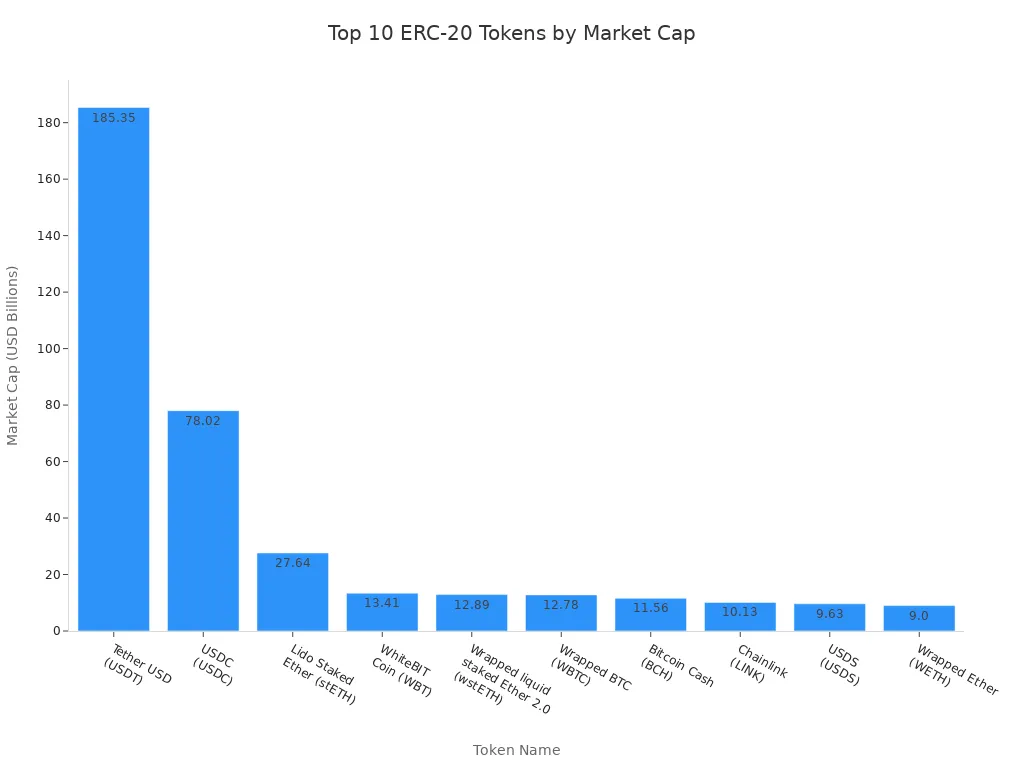
You see many erc20 tokens in the crypto market, but some stand out because of their size and use. These erc-20 tokens have become important parts of the ethereum ecosystem. The table below shows the top erc-20 tokens by market capitalization:
Rank | Token Name | Price | Market Cap |
|---|---|---|---|
1 | Tether USD (USDT) | $1.00 | $185.35 billion |
2 | USDC (USDC) | $1.00 | $78.02 billion |
3 | Lido Staked Ether (stETH) | $3,188.97 | $27.64 billion |
4 | WhiteBIT Coin (WBT) | $62.51 | $13.41 billion |
5 | Wrapped liquid staked Ether 2.0 (wstETH) | $3,896.57 | $12.89 billion |
6 | Wrapped BTC (WBTC) | $92,959.45 | $12.78 billion |
7 | Bitcoin Cash (BCH) | $579.04 | $11.56 billion |
8 | Chainlink (LINK) | $14.54 | $10.13 billion |
9 | USDS (USDS) | $1.00 | $9.63 billion |
10 | Wrapped Ether (WETH) | $3,193.50 | $9.00 billion |
USDT
You use USDT, also known as Tether, as a stablecoin that keeps its value close to one US dollar. Many people choose USDT for trading and moving money across exchanges. You can trust USDT because it stays stable, even when the crypto market changes quickly. USDT helps you avoid price swings and makes it easier to use defi platforms.
UNI
You find UNI as the main token for Uniswap, a popular decentralized exchange on ethereum. When you hold UNI, you can vote on changes to the Uniswap platform. You also use UNI to earn rewards and take part in governance. UNI shows how erc-20 tokens can give you a voice in defi projects.
LINK
You see LINK as the token for Chainlink, a network that connects smart contracts to real-world data. You use LINK to pay for services on the Chainlink network. Many defi apps depend on Chainlink to get accurate data, so LINK plays a key role in the ethereum ecosystem.
Applications in DeFi and Gaming
You use erc20 and erc-20 tokens in many defi platforms. These tokens let you lend, borrow, and earn interest without banks or middlemen. You can use stablecoins like USDT or USDC to store value and make fast payments. On lending platforms, you lend your erc-20 tokens to earn interest or use them as collateral to borrow other assets. You also trade erc20 tokens on decentralized exchanges, where you swap assets directly with other users. Yield farming lets you earn extra rewards by providing liquidity to defi pools.
You also see erc20 tokens in blockchain-based gaming. These tokens help you buy in-game items, join special events, or even vote on game updates. Game developers use erc-20 tokens to raise funds and build strong game economies. You enjoy a smooth experience because erc20 tokens work with many apps and wallets. This makes it easy for you to move assets between games and defi platforms.
Tip: You can use the same erc20 wallet for both defi and gaming. This gives you more control and flexibility with your digital assets.
You see how erc-20 tokens power both finance and entertainment on ethereum. These real-world uses show why erc20 and defi have become so important in the crypto world.
Risks and Limitations
Security Concerns
You need to stay alert when you use erc20 and erc-20 tokens. These digital assets run on smart contracts, which can have flaws. Hackers often look for bugs in smart contracts to steal funds. You also face the risk of scams and phishing attempts. Many people try to trick you into sending your tokens to fake addresses. Once you send a transaction, you cannot reverse it. This means you could lose your tokens forever if you make a mistake.
Here is a table that shows the main security concerns you should know:
Security Concern | Description |
|---|---|
Vulnerabilities in smart contracts | ERC-20 tokens are built on complex smart contracts that can contain bugs, increasing hack risks. |
Irreversibility of transactions | Once a transaction is made, it cannot be reversed, leading to potential loss of funds. |
Risks of scams and phishing attempts | Users are often targeted by scams that exploit the popularity of ERC-20 tokens. |
Tip: Always double-check wallet addresses and use trusted platforms when you send or receive tokens.
Common Vulnerabilities
You should understand the common vulnerabilities that affect erc20 smart contracts. Some contracts have coding errors that hackers can exploit. Overflow vulnerabilities happen when numbers go beyond their limits, causing unexpected results. Unprotected functions let anyone access parts of the contract that should stay private. These problems can lead to loss of funds or control over your tokens.
The table below lists the most common vulnerabilities:
Vulnerability Type | Description |
|---|---|
Overflow vulnerabilities | Exploiting integer overflow or underflow, leading to results outside the representable range. |
Unprotected function vulnerability | Occurs when access restrictions are not properly implemented, allowing unauthorized function access. |
Note: You can reduce your risk by using well-audited contracts and keeping your wallet secure.
Limitations of ERC-20
You may notice that erc-20 tokens have some limits. The ethereum network can get crowded, which slows down transactions and raises fees. Smart contracts that power erc20 tokens can still get hacked, even with audits. The erc-20 standard only supports basic functions, so you cannot use it for every possible use case. Some projects need more features and must create new standards. You also face challenges with regulations, since rules for digital assets keep changing.
Here are the main limitations you should consider:
The Ethereum blockchain's scalability limitations can affect the performance of erc20 tokens during periods of high network congestion, leading to slower transactions and higher fees.
Smart contracts powering erc20 tokens are susceptible to hacks and vulnerabilities, which can result in the loss of funds or token theft.
ERC20 tokens have predefined functions and events, which might not cover all possible token functionalities, necessitating custom standards for complex use cases.
Regulatory compliance issues arise as erc20 tokens operate in a gray area, making it challenging for issuers and holders to navigate evolving regulations.
Alert: Always research the project and understand the risks before you invest in or use new tokens.
Comparing ERC-20 to Other Standards
ERC-20 vs ERC-721
You often hear about both erc20 and erc-721 standards when you explore digital assets. These two standards serve different purposes on ethereum. The erc20 standard works best for creating tokens that are all the same, while erc-721 is used for unique items like NFTs. You can see the main differences in the table below:
Aspect | ERC-20 | ERC-721 |
|---|---|---|
Definition | A standard for fungible tokens on Ethereum. | A standard for non-fungible tokens (NFTs) on Ethereum. |
Fungibility | These tokens are fungible in nature. | These tokens are non-fungible in nature. Each NFT has a unique tokenId. |
Substitution | They're easier for substitution. | There is no scope for substitution. |
Divisibility | They're divisible; can be split into smaller units. | They're not divisible at all. |
Ownership | No special ownership functions can be allocated. | Special ownership functions can be enabled by these tokens. |
You use erc20 when you want to create digital currencies or reward points. You use erc-721 for collectibles, art, or game items that must be one-of-a-kind.
Tip: If you want to own a unique digital item, look for erc-721 tokens. If you want to trade or use identical units, erc20 is the better choice.
ERC-20 vs ERC-1155
You may also come across erc-1155, another standard that brings more flexibility. While erc-20 focuses on one type of asset per contract, erc-1155 lets you manage many types of assets in a single contract. This makes it popular for gaming and apps that need both unique and identical items. The table below shows how these two standards compare:
Feature | ERC-20 | ERC-1155 |
|---|---|---|
Year Introduced | 2015 | 2018 |
Asset Representation | Single asset per token | Multiple assets per token |
Transaction Efficiency | Individual transfers | Batch transfers |
Use Cases | General digital assets | Gaming items, multiple asset types |
Customizability | Highly customizable | Flexible, supports various asset types |
You choose erc-20 when you need simple, identical tokens. You pick erc-1155 if you want to handle many assets at once, like in a game where you need both coins and rare items.
Note: Batch transfers in erc-1155 can save you time and reduce transaction costs, especially in games or apps with lots of items.
Unique Role of ERC-20
You see the unique role of erc-20 tokens every time you use decentralized apps or exchanges. The erc-20 standard gives you a common set of rules, making it easy for different apps to work together. This standard has helped drive innovation, especially in decentralized finance. You benefit from fast, reliable transactions and wide support across the ethereum ecosystem. The erc-20 standard has made it possible for you to use tokens in many ways, from trading to lending and more.
The erc-20 standard acts as a bridge, helping you move assets smoothly between platforms and boosting the power of decentralized applications.
Future of ERC-20 Tokens
Evolving Standards
You will see new standards appear as the future of erc-20 unfolds. Developers in the ethereum community continue to create advanced token types. Standards like ERC-777 and ERC-1155 offer new features that improve how you use tokens. These upgrades can make transactions faster and add more security. Some of these new standards may even replace certain functions of erc20. You might notice that ERC-777 allows for more flexible interactions, while ERC-1155 lets you manage different types of assets in one contract.
Here are some ways new standards could shape the future of erc-20:
You may experience lower transaction fees as new standards improve efficiency.
You could see better security features that protect your tokens from common attacks.
You might use tokens that work across more apps and blockchains, thanks to better interoperability.
You should know that even with these changes, erc-20 tokens still play a big role. Many apps and wallets support erc20, so you will continue to use them for a long time.
Tip: Stay updated on new token standards. This helps you make smart choices about which tokens to use or invest in.
Ongoing Relevance
You will find that the future of erc-20 remains strong, even as technology changes. The growth of decentralized finance depends on standards that everyone trusts. You use erc-20 tokens in many DeFi apps, and this will not change soon. As the ethereum ecosystem grows, you will see more projects that rely on these tokens for trading, lending, and governance.
The future of erc-20 also faces some challenges. You may notice delays in transactions or higher fees during busy times. Security issues sometimes affect smart contracts, which can put your tokens at risk. Because of these problems, the community looks for alternatives like ERC223 and ERC777. Still, erc-20 stays the most popular choice for new projects.
You can expect the future of erc-20 to include both improvements and competition. Developers will keep building better standards, but erc-20 tokens will stay important for years. You should watch for updates and learn how new standards might affect your experience.
Note: The future of erc-20 will bring new opportunities and challenges. You can prepare by learning about the latest trends in ethereum and token technology.
You have seen how erc20 and erc-20 tokens shape the crypto world. These tokens give you a common framework for building and using digital assets. Their impact includes:
Driving the growth of decentralized apps and DeFi
Enabling thousands of new tokens and ICOs
Inspiring new standards to address security and limitations
Looking ahead, you will notice changes like Ethereum 2.0, Layer 2 solutions, and tokenized assets making these tokens even more useful. If you want to learn more, check out these resources:
Resource Title | Description |
|---|---|
Comprehensive guide covering various Ethereum token standards including ERC20, ERC721, and ERC1155. | |
The Ultimate List of ERC Standards You Need To Know | Detailed overview of popular ERC standards, including their functionalities and use cases. |
FAQ
What makes ERC-20 tokens different from other cryptocurrencies?
ERC-20 tokens follow a standard set of rules on Ethereum. You can use them in many wallets and apps. Other cryptocurrencies, like Bitcoin, have their own blockchains and do not follow the ERC-20 standard.
Can you create your own ERC-20 token?
Yes, you can create your own ERC-20 token. You need to write a smart contract using Solidity, test it, and deploy it on Ethereum. Many online tools and templates help you start.
Are ERC-20 tokens safe to use?
ERC-20 tokens are safe if you use trusted contracts and platforms. Always check for audits and reviews. > Tip: Never share your private keys and always double-check addresses before sending tokens.
How do you store ERC-20 tokens?
You store ERC-20 tokens in Ethereum wallets like MetaMask, Trust Wallet, or Ledger. These wallets support the ERC-20 standard and let you send, receive, and check your token balances.
What fees do you pay when sending ERC-20 tokens?
You pay a gas fee in ETH for every ERC-20 token transaction. The fee depends on network activity. You do not pay fees in the token itself, only in ETH.
Can you recover ERC-20 tokens sent to the wrong address?
No, you cannot recover tokens sent to the wrong address. Blockchain transactions are final. Always double-check the address before sending.
Alert: Sending tokens to an unsupported wallet or contract may result in permanent loss.
Tech