What Is a Prediction Market?
A prediction market is a trading environment where participants buy and sell contracts tied to the outcome of future events. Prediction markets are systems designed to estimate the probability of future events by allowing people to trade on outcomes. Instead of relying only on surveys or expert opinions, these markets aggregate information through financial incentives, turning collective beliefs into real-time probabilities. These events can range from election results and sports matches to economic indicators, technology launches, or even scientific breakthroughs.
Each contract represents a specific outcome, and the price of that contract fluctuates based on supply and demand, effectively reflecting how likely the market believes the event is to occur. In simple terms, the market price becomes a probability indicator.
For example, if a contract is trading at $0.30, the market is implying there is roughly a 30% chance of that outcome happening.
How Prediction Markets Work
Prediction markets operate similarly to financial markets but focus on event outcomes rather than assets. Participants trade based on their knowledge, research, or intuition. Users can buy contracts whenever they want, but they typically buy when they think the market is underestimating an event’s probability and sell when they think it is overestimating it.
When new information becomes available, such as news, data releases, shifts in public sentiment, or expert analysis, participants adjust their positions. This continuous trading process allows the market price to update dynamically, making prediction markets a real-time forecasting mechanism.
The key idea is that people who are confident in their predictions are willing to risk money, which tends to produce more honest and informed forecasts than opinion polls or public commentary.
Use Cases of Prediction Markets
Prediction markets have applications across many industries:
Politics – Forecasting election outcomes, policy decisions, and geopolitical events.
Sports – Predicting match winners, tournament results, and player performance.
Finance and Economics – Estimating inflation rates, interest rate changes, or market movements.
Technology and Startups – Predicting product launches, adoption rates, or industry trends.
Corporate Decision Making – Companies use internal prediction markets to forecast project timelines, sales performance, or product success.
Platforms such as Polymarket have made prediction markets more accessible by allowing users to trade on real-world events through blockchain-based infrastructure, improving transparency and global accessibility.
Why Prediction Markets Are Often Accurate
Prediction markets are frequently considered more reliable than traditional forecasting methods because they combine several important factors:
Financial incentives – Participants are motivated to be correct because incorrect predictions lead to financial loss.
Information aggregation – Markets combine knowledge from many individuals, including experts, insiders, and analysts.
Real-time updates – Prices change immediately when new information appears.
Bias reduction – Unlike media or surveys, markets reflect what people actually believe, not what they say publicly.
This combination often leads to highly efficient forecasts that reflect collective intelligence rather than individual opinion.
Source: https://www.aeaweb.org/articles?id=10.1257%2F0895330041371321&utm_source
Social Impact of Prediction Markets
Beyond trading and speculation, prediction markets have broader social implications. They can improve decision-making in governments, corporations, and research institutions by providing data-driven forecasts. They also create transparency around public expectations and future events.
In the long term, prediction markets could play a role in governance, economic planning, risk management, and even scientific research forecasting. By turning predictions into markets, society gains a mechanism to quantify uncertainty and collective expectations in a measurable way
The Role of Market Integrity and Standards
As prediction markets grow, an important question emerges: not all markets are socially beneficial. Some markets may create incentives around harmful events, disasters, or unethical outcomes. This introduces moral hazard, where market participants could potentially benefit from negative real-world events.
To address this issue, new frameworks are being developed to ensure that prediction markets are created responsibly. One example is NERO ABCP (Certified Fair Markets), a mathematical framework designed to maintain prediction market integrity. NERO ABCP provides a blockchain-verifiable standard that evaluates whether a market’s incentives are aligned with positive or neutral outcomes rather than harmful scenarios.
Under this framework, a market can be approved only if the incentive structure does not encourage unethical behavior or benefit from real-world harm. This approach helps prevent problematic markets such as those related to deaths, disasters, or market manipulation scenarios. In this sense, frameworks like ABCP may play an important role in shaping the future of responsible prediction markets by introducing standards, governance, and ethical market design.
NERO’s Efforts in Prediction Markets
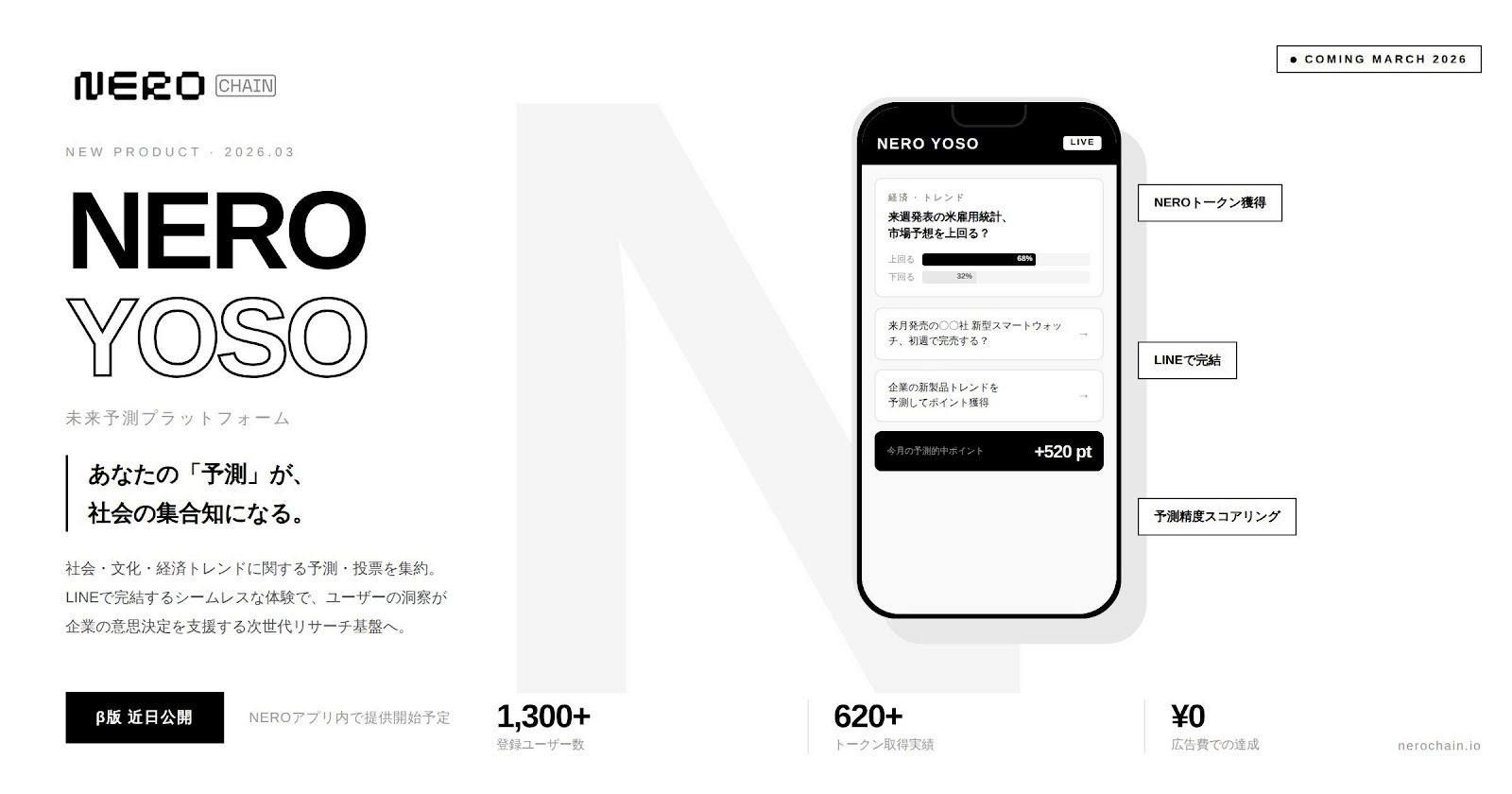
NERO is building prediction market infrastructure at both the application and protocol level. One example is NERO YOSO, a prediction and polling platform launched in Japan that focuses on social, cultural, and economic trends. Instead of purely speculative markets, the platform combines forecasting, public sentiment, and trend prediction, making prediction markets more accessible to everyday users. YOSO is fully compliant with local regulations, ensuring a safe and trustworthy environment for participants.
NERO YOSO is integrated into the LINE NERO app, where users can participate in predictions in a simple and familiar environment. This approach lowers the barrier to entry and introduces prediction markets to mainstream users who may not be familiar with blockchain or trading platforms.
At the same time, NERO is also developing global prediction market infrastructure built on a fully on-chain protocol. In this system, users trade binary outcomes (YES/NO) on real-world events using an automated market maker, with fully collateralized positions and deterministic settlement mechanisms. The goal is to combine DeFi-level market mechanics with Web2-level user experience, including social login, gas abstraction, and simplified onboarding
Conclusion
Prediction markets transform forecasting into a market-driven process where prices represent collective expectations about the future. By aligning financial incentives with accurate predictions, these markets often produce reliable probability estimates across politics, economics, sports, and technology.
As the industry evolves, the future of prediction markets will likely depend on three key developments: better user experience, infrastructure-level integration, and responsible market design. Platforms and frameworks such as embedded prediction infrastructure and integrity standards may help prediction markets move beyond standalone trading platforms and become decision-making tools embedded across digital platforms, organizations, and online ecosystems.
In the long term, prediction markets may not only be places where people trade on the future, but also infrastructure that helps applications, companies, and societies better understand uncertainty, measure expectations, and make more informed decisions.
Website丨 X (Global)丨X (Japan)丨Telegram丨Discord
Note: The information contained in this blog is accurate as of the date of publication and is subject to change without notice.
This blog is provided for informational purposes only and does not constitute investment solicitation.